
On 2 June 2026 we ran a workshop for second-year psychology undergraduates at Aston University, as part of the Digital Futures Psychology Immersive Accelerator run by We Job Box. It was the third and most ambitious session in a partnership that began with a 100-student sustainability challenge in October 2025. The brief was unusual and, for us, ideal: give psychology students a real behaviour-change problem to solve.
The problem we handed them
Psychology students spend three years learning models of behaviour and rarely get to point them at a live problem with real constraints. So we gave them ours.
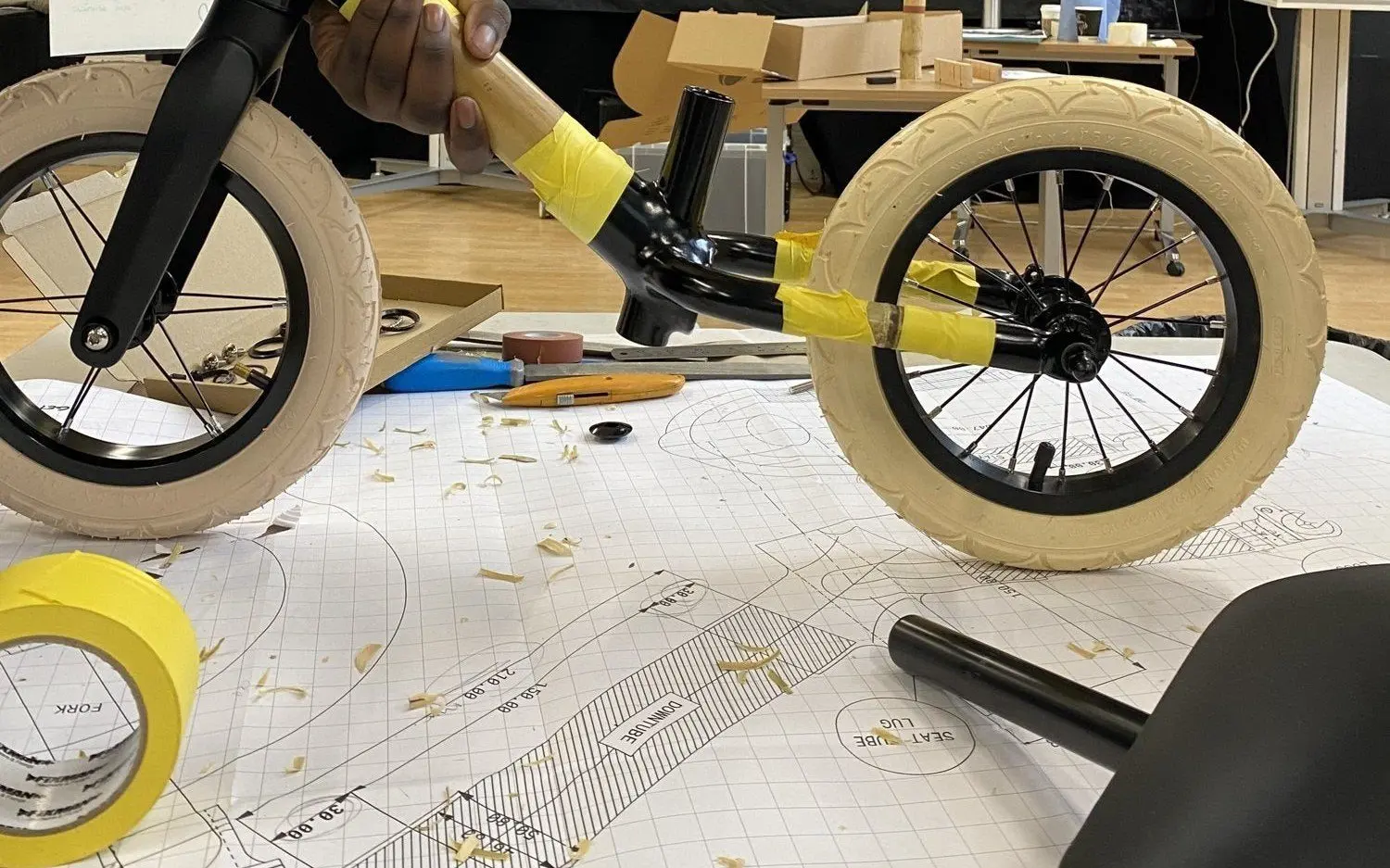
Our prison work runs as two programmes, both accredited by OCN London at Level 2: the six-week training (1130735) and the two-week Build to Bond (1131207), in which Makers build a balance bike for a child in their family. Running them well raises hard design questions: how do you get someone to sign up in the first place, how do you keep them coming back, how do habits survive the gate on release, how do you make a first session feel safe, how do you sustain motivation across a long sentence, and how do you turn the strongest learners into peer instructors?
Each team took one of those questions, based on a real case study from our prison work, and had two and a half hours to design something better.
How the session worked
Five teams. Each team got a case-study brief, a behaviour-change lens to work with (COM-B, Fogg’s model, nudge theory, self-efficacy, hope theory) and a structured set of deliverables: who exactly is the person you are designing for, what specific behaviour are you trying to change, what is your solution, and would it actually survive contact with a prison regime and budget.
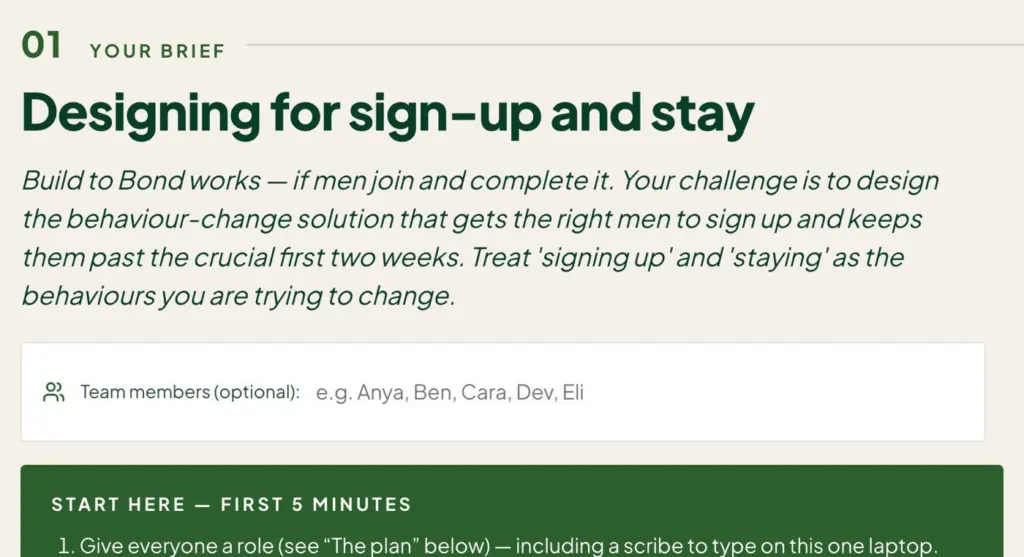
We built a purpose-made browser tool for the day. Each team worked on one laptop with their brief, a running timer, phased prompts and autosaving answers; at the end, the facilitator projected each team’s work while they presented it back. That kept slide decks and document-hunting out of the way and the room’s whole attention on the thinking.
The deliberate choice was to keep the theory mainstream rather than forensic. These are generalist psychology students, not criminologists, and the aim was to show that the models they already know are tools for designing things people actually do.
What the cohort said
Every team that returned feedback rated the session: an average of 4.64 out of 5 across five responses, and all five would recommend it to other students. Teamwork and real-world relevance scored highest, at 4.8 out of 5 each. We report those figures as indicative rather than representative: five responses is a small sample, attendance on the day came in below the organisers’ forecast at fourteen of twenty-five booked places, and we audited the raw returns before counting them. We have asked We Job Box for their own evaluation so the next write-up can carry an independent read alongside ours.
“It all linked to real prisons and real problems — that made it that bit more interesting!”
Psychology student, Aston University
“The most interesting part was trying to find a solution for a real-life problem and putting our skills together as a group.”
Psychology student, Aston University
What the student teams proposed
These are student concepts, not programmes we run or have tested. Teams applied named psychological theory to the realities of the prison they had been given, and several went beyond the brief to cite research. Three examples:
- Keeping habits alive after release. Citing Lally et al. (2010) on how repetition in stable contexts makes behaviour automatic, the team matched each person to a community bike project near home before release, with a named mentor making contact within 24 hours and a workshop place within 48 (their proposal, not our practice), alongside housing and travel support. The point: make release an entry into a community rather than a return to isolation.
- A first session that feels safe, in a women’s prison. Drawing on Bandura’s self-efficacy, self-determination theory and social identity theory: a female facilitator alongside a peer who has been through it, circle seating, explicit ground rules, and a low-stakes first win before anyone touches a bike frame.
- Graduates mentoring the next group. Using social identity theory (people trust peers who share their background more than they trust staff), with mentors matched on shared characteristics, and the benefits to the mentor themselves treated as part of the design.
What We Job Box said
“… engaging workshops delivered by Irwin Mitchell and Bamboo Bicycle Club, both of which were extremely well received by the students. They learned a great deal, participated enthusiastically, and fully engaged with the sessions.”
Lalita Taylor, Founder, We Job Box
Students asked for two things next time: a one-page case pack two to three days ahead, and more time to prepare their presentations.
Why this matters to us
Most of our education work puts tools in people’s hands. This was different: the students never touched a bamboo tube. What they got was the design problem behind the programme, and what we got was five useful outside perspectives on questions we live with.
This was the third of four workshops we have delivered with We Job Box. A design-thinking sprint with the University of Surrey followed a week later. If you run an employability programme, a university module or a careers accelerator and want a session with a real problem at the centre of it, have a look at what we do and start a conversation.