

People often ask the same question before they build with bamboo: will it actually hold up? So we sent our bamboo to an engineering lab and had it tested to a recognised international standard.
Context
Bamboo is a naturally occurring composite: longitudinal cellulose fibres set in a lignin matrix, with fibre density increasing toward the outer wall of the culm. Every culm is slightly different, so the only honest way to talk about strength is to measure it.
What we did
In partnership with Swansea University, bamboo culms supplied by Bamboo Bicycle Club were tested to BS ISO 22157:2019, the international standard for determining the physical and mechanical properties of bamboo.
- 14 culms were sent (labelled A to N), and the 6 highest-quality specimens were selected for testing.
- Flexural (three-point bending): load applied at a node over a 300 mm span.
- Tensile: 180 × 8 × 3 mm specimens with epoxy-attached tabs, pulled at 2 mm/min.
- Compressive: tested to the same ISO standard.
The results
- Flexural, Young’s modulus (average): 6,402.93 MPa
- Flexural, ultimate flexural stress (average): 70.96 MPa
- Tensile, ultimate tensile stress (average): 84.34 MPa
- Compressive, ultimate compressive stress (average): 57.7 MPa
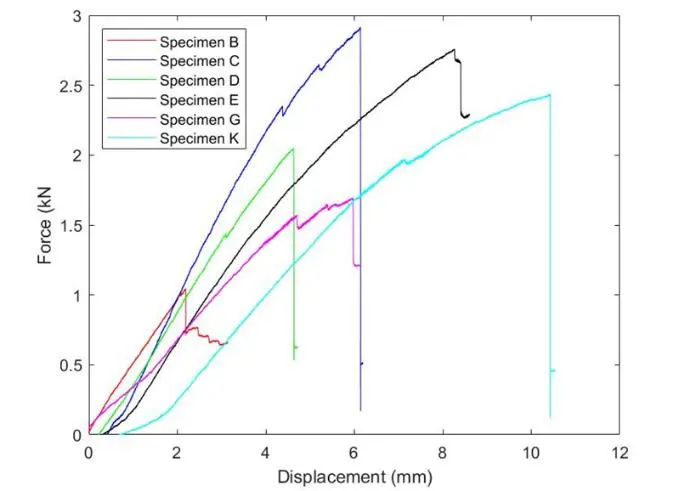
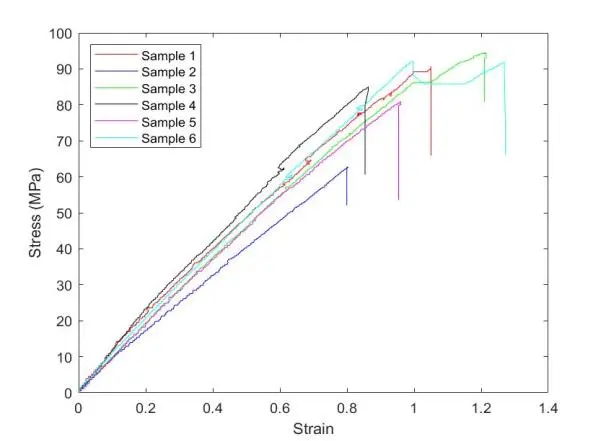
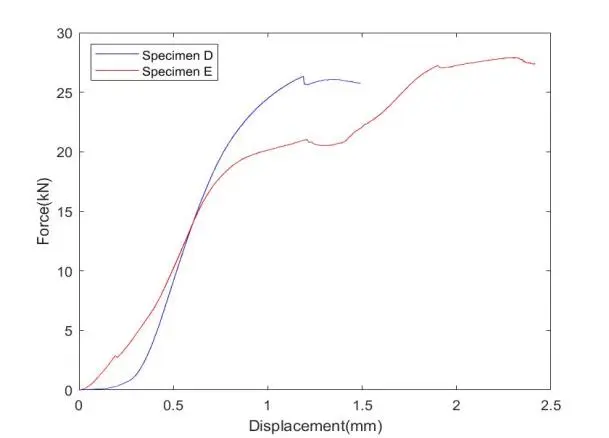
The bamboo showed little to no plastic deformation. It carried load and then failed once the maximum bending moment was reached, rather than slowly bending out of shape. Results varied between specimens, as you would expect from a natural material with differing diameters, wall thicknesses and natural defects.
What this covers
This is a measurement taken in a university lab to a published international standard. Swansea tested our bamboo tubing, not a finished frame. How a frame performs also depends on its joints and on how carefully it is built.